Wednesday, March 20, 2013

To the Moon and Back

 In real life a full moon can look like this:

 And the moon can look different as it changes:

In art the moon can look a lot of different ways. Part of art is "interpretation", which means people can see things many different ways. No one way is right or wrong. It's just different. And you may find you like some "interpretations" more than others. And that is just fine. 

The moon is hiding behind the clouds, but also looks kind of like the glow of the streetlamp. 
 
New York With Moon - Georgia O'Keeffe

In this painting the moon helps frame the flowers.
Autumn Flowers in Front of Full Moon - Hiroshige

The moon is high up in the sky, and the bunnies are looking up to see it.
Rabbits Under Moon - Hiroshige

These paintings are interpretations of the moon. They don't look like the real life moon, but they have a round circle which the artist uses as the moon. This is called abstract, which means something doesn't have to look like it does in real life. But if you look at it, you may get a feeling of what it is even if it doesn't look like the real life thing.
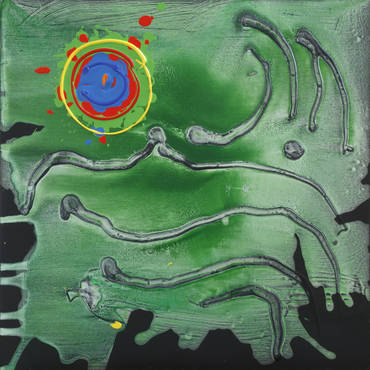
Green Sea Moon - John Hoyland (2006)

Blue Moon - John Hoyland (2006)

 Vincent's Moon - John Hoyland (2007)

Moon's Milk - John Hoyland (2009)

These paintings are abstract as well. Can you see where the artist put the moon?
 Fire Full Moon - Paul Klee (1933)

 
Full Moon - Paul Klee (1919)

Even though we can't see the faces of the boy and girl, you know they are looking at the moon. 
Do you think they're smiling? Do you think they're talking? What would they talk about?
Boy and Girl Gazing at the Moon - Norman Rockwell (1926)

These paintings have big full moons in the sky above nature scenes. 
They are dark colors which can make people think of night time.
Grasshopper and Fool Moon - Ohara Koson (1910)

 
Cherry on a Moonlit Night - Ohara Koson (1932)

These paintings are dark as well and there are a lot of shadows. The moon is very bright. It might almost look like the sun if the rest of the painting wasn't dark to make you think of night time.
Moonlight Study at Millbank - William Turner (1797)

Fishermen at Sea - William Turner (1796)


Friday, March 8, 2013

Dog Gone It! (Man's Best Friend in Art)

Dogs are called "mans best friend" and often times in paintings, they can be a symbol for friendship. They can also mean guidance, protection, loyalty, or faithfulness. 

Dogs have been around a long time. Even hundreds of years ago humans and dogs were buddies.
This is a painting done on a cave a very long time ago
showing a hunter and his dog.


In other pieces of art done a long time ago, dogs are shown to.
Like in mosaics (pictures made up of tiny pieces, like a puzzle)
and stone carving.
Dog Mosaic at the Olearie Exhibit – Rome, Italy

Cave Canem – Mosaic dog – Pompeii, Italy
 
Assyrian carving


And since dogs are called "mans best friend", they are often
shown with people as their friends.
A Girl - David Burliuk
 
 A Ride Through Water
 
Dog 3-Briton Riviere
 
Tahitian Pastorale - Paul Gaugin (1898)

Sara With Her Dog - Mary Cassatt
 
Costume Design - Woman Dressed in Black With Furs, Hat,
 and Dog On A Lead -Erte
 
The Watermelon - Grace Hudson

Boy With A Dog - Pablo Picasso (1905)


And sometimes a dog's buddy doesn't have to be a person.
Doubtful Crumbs - Edwin Henry Landseer (1858)

At The Stables - Edgar Degas
 
Sometimes dogs will get their very own pictures painted.
A Sleeping Dog With Terracotta-Pot - Gerrit Dou (1650)

Head Of A Dog - Edouard Manet (1876)
 
Loup-Garou -  George Rodrigue (1991)

Study Of A Dog - Jean Leon Gerome

And sometimes pictures of dogs might seem a little weird or different. But there are many different ways to show things in art.
Dog Barking At the Moon - Joan Miro (Joan=Juan)
Portrait Of Maurice - Andy Warhol (1976)

This painting is called "His Master's Voice" and shows a
dog listening to his owner's voice on an old record player.
 
This painting call  "Their Master's Voice" by Michael Sowa shows A LOT of dogs listening to an old record player.

Little Dog's Rock - Jacek Yerka
Do you see the dog in the rocks?

And it's not just pictures. Puppies and dogs can be made into sculpture to.
Puppy" by Jeff Koons is 43 feet high and made of flowers!
 
Balloon Dog is 10 feet high!
He is made of stainless steel.

(Note to parents: If you Google Jeff Koons, be aware he has some racy pieces that may come up. It's not all puppies and kittens.)


Monday, January 7, 2013

Henri Rousseau (Lions, and Monkeys, and Jungles. And a bunny too, oh my!)

Henri Rousseau was famous for his jungle scenes. Below are monkeys and lions and JUNGLES!

Apes In The Orange Groves

- How many monkeys are in the trees?
- Do you like oranges?
- How many oranges do you think are in those trees?
Apes in the Orange Grove - Henri Rousseau


Exotic Landscape  (1908)
- MORE monkeys!
- Do you see the bird in the middle of the picture?
Exotic Landscape - Henri Rousseau

Landscape with Monkeys (1908)
- Does the bird in this picture look like the bird in the picture above?
- Do you see the orange sun behind the big leaves?
Landscape with Monkeys - Henri Rousseau
 

Exotic Landscape  (1910)
- What are the monkeys in the tree doing?
- Do you think monkeys like oranges? 
Exotic Landscape - Henri Rousseau 


Rabbit  (1908)
- How many carrots is the rabbit eating?
- Do you like carrots?
Rabbit - Henri Rousseau


The Monkeys In The Jungle (1909)
- MORE monkeys!
- Do you see the big leaves on the trees?
The Monkeys in the Jungle - Henri Rousseau


Tiger In A Tropical Storm (Surprised)  (1891)
- How do you think the tiger feels?
- What is the weather like?
Tiger in a Tropical Storm (Surprised!)  - Henri Rousseau

Tropical Forest With Apes and Snake  (1910)
- Do you see the snake behind the white flowers?
- How many monkeys are in the painting?
- Do you like the patterns of all the different jungle leaves?
Tropical Forest with Apes and Snake - Henri Rousseau
 

Woman In Red In The Forest (1907)

Woman in Red in the Forest  - Henri Rousseau

Woman Walking In An Exotic Forest (1905)
Woman Walking in an Exotic Forest  - Henri Rousseau
Do these 2 pictures look similar?
Why do you think so?


Mandrill in the Jungle (1909)
-Does this monkey look like the monkeys in the other paintings?
Mandrill in the Jungle - Henri Rousseau

Henri Rousseau
SHORT BIOGRAPHY
Born: 21 May 1844; Laval, Mayenne, France
Died: 02 September 1910; Paris, France
  • Henri Rousseau was completely self taught.
  • Best known for his naïve, or primitive, childlike jungle scenes
  • Good at painting and music as a child
  • Spent most of his life as a customs officer. Because of this, he was also referred to as "Le Douarneir", or the “Customs Officer.”
  • Started painting seriously at the age of 40. By the time he was 49, he retired from his job to paint full time.
  • Mainstream painters did not embrace his style
  • BUT he was highly regarded by "outsider artists", such as Picasso, Jean Hugo, Leger, Beckman
  • He was unaware he was considered untrained, and regarded himself very highly. In his opinion, Picasso and he were the only two great living artists.
  • Many of his paintings were jungle scenes, although he had never been to a jungle (he actually never left France!) but he made many trips to botanical gardens, read picture books, and studied taxidermy animals
  • He interviewed many soldiers who had served in the jungle in Mexico about their travels through the subtropics.
  • His work has also been an inspiration for the contemporary animated film “Madagascar.”
Self Portrait from L'ile Saint Louis - Henri Rousseau

Self Portrait from L'ile Saint Louis (1890)